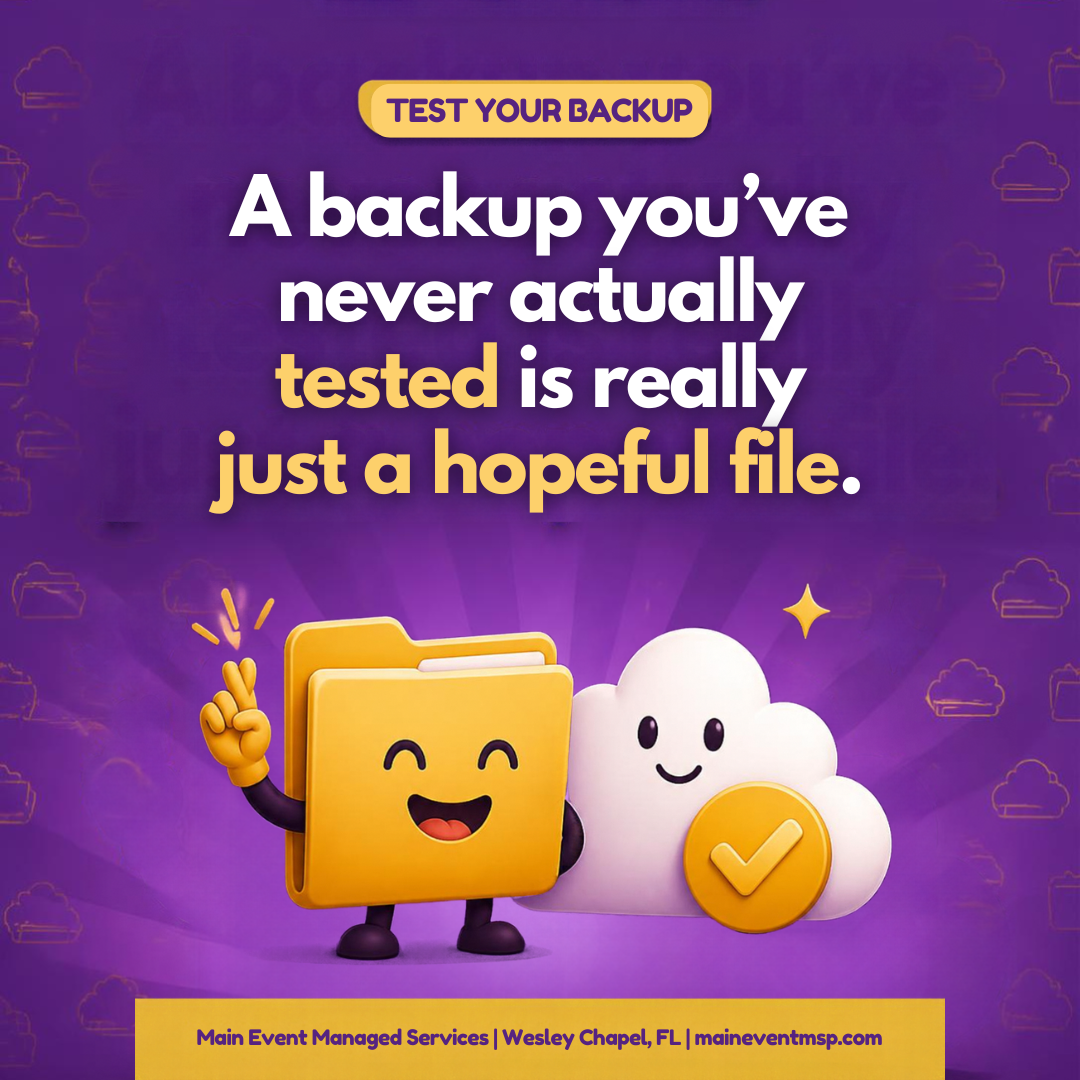
A Backup You've Never Tested Is Really Just a Hopeful File
Almost every business we talk to around Wesley Chapel and Tampa Bay has some kind of backup running. A cloud service, an external drive, a managed backup through their IT provider, something. That's genuinely good news. The less good news is that having a backup and knowing your backup actually works are two different things, and a lot of businesses have only ever confirmed the first one.
The gap between "it ran" and "it works"
Most backup software gives you some kind of confirmation that a job completed. A green checkmark, a summary email, a dashboard that says everything's fine. That's useful information, but it only tells you the backup process finished without an obvious error. It doesn't tell you the files inside are complete, uncorrupted, and actually usable if you needed them tomorrow.
There are a handful of ways a backup can look successful on paper while still failing you when it counts. A misconfigured folder gets skipped silently. A file gets backed up in a partially corrupted state. Permissions issues prevent a restore from completing the way you'd expect. None of these show up as an error message during the regular backup job, they only show up when someone actually tries to pull a file back.
Why this gets skipped so often
Testing a restore feels like extra work for something that's probably fine, and most of the time, it is fine. That's exactly the trap. Backups quietly work for months or years, which builds a false sense of confidence, right up until the one day something actually goes wrong and the restore doesn't behave the way everyone assumed it would. By then it's not a ten minute test anymore, it's a real problem happening in real time.
A simple quarterly habit
• Pick one file or folder, not everything. You don't need to restore your entire system to learn something useful. A single recent file tells you a lot.
• Actually restore it, not just locate it. Pull it out of the backup and into a normal, usable location, the same way you would in a real recovery situation.
• Time how long it takes. If your business could only tolerate an hour of downtime but a full restore would take a day, that's worth knowing now, not during an actual outage.
• Open it and check it. Confirm the file is complete, opens correctly, and matches what you'd expect. A restored file that won't open is the whole ballgame right there.
• Write down the date. A simple note of when you last tested, and what you found, turns this into a repeatable habit instead of a one-off favor to future you.
Ten minutes, once a quarter, roughly forty minutes a year. That's a small price for knowing your safety net actually holds weight.
The 3-2-1 rule, as a refresher
While you're thinking about backups, it's worth double checking the shape of your setup too. A commonly used guideline is three copies of your data, on two different types of storage, with at least one copy kept offsite or offline. This matters because a backup stored only on the same network as your main systems can be affected by the same problem, a ransomware attack, a fire, a hardware failure, that took out the original data in the first place.
What it feels like once you've actually done it
The first time you run a real restore test, there's a decent chance you'll find something small worth fixing, a folder that wasn't included, a permission that doesn't carry over cleanly, a restore that takes longer than expected. That's a good outcome, not a bad one. Finding it during a calm, scheduled test means fixing it on your own timeline instead of discovering it during an actual emergency, when every extra hour matters.
What good backup habits look like at a business level
For a small business, this doesn't need to be one person's private ritual. It works better as a scheduled, shared responsibility, on the calendar the same way a monthly financial review would be, with someone specifically accountable for doing it and a simple log of the results. That way it survives vacations, turnover, and the general busyness of running a business, rather than depending on one person remembering.
What this means for Florida insurance agencies
Insurance agencies rely on client files and policy records being available when they're needed, sometimes urgently. Florida Administrative Code Rule 69O-128.032 calls for a written information security program with administrative, technical, and physical safeguards for customer information, scaled to the size of the agency. A documented backup testing routine, with a real date and a real result each quarter, is a concrete example of a technical safeguard that's easy to point to if anyone ever asks how your agency protects its data.
Main Event Managed Services helps Wesley Chapel and Tampa Bay businesses, including Florida insurance agencies, set up backups that are actually tested on a schedule, not just running quietly in the background. Visit maineventmsp.com to talk through your setup.