This week, SecurityWeek reported that a leaked key at a vendor put the data of roughly 238,000 members of a Denver health plan at risk. The full details of how the key was exposed will come out over time, but one part of the story is already clear. The members whose information is at risk never chose that vendor. They chose the health plan, and the health plan's name is the one in the headline.
That's the uncomfortable truth about vendor risk. Your clients trust you, not the software companies, service providers, and contractors you rely on behind the scenes. When one of those partners makes a mistake, the fallout lands on your doorstep.
Why Vendors Are the Soft Spot
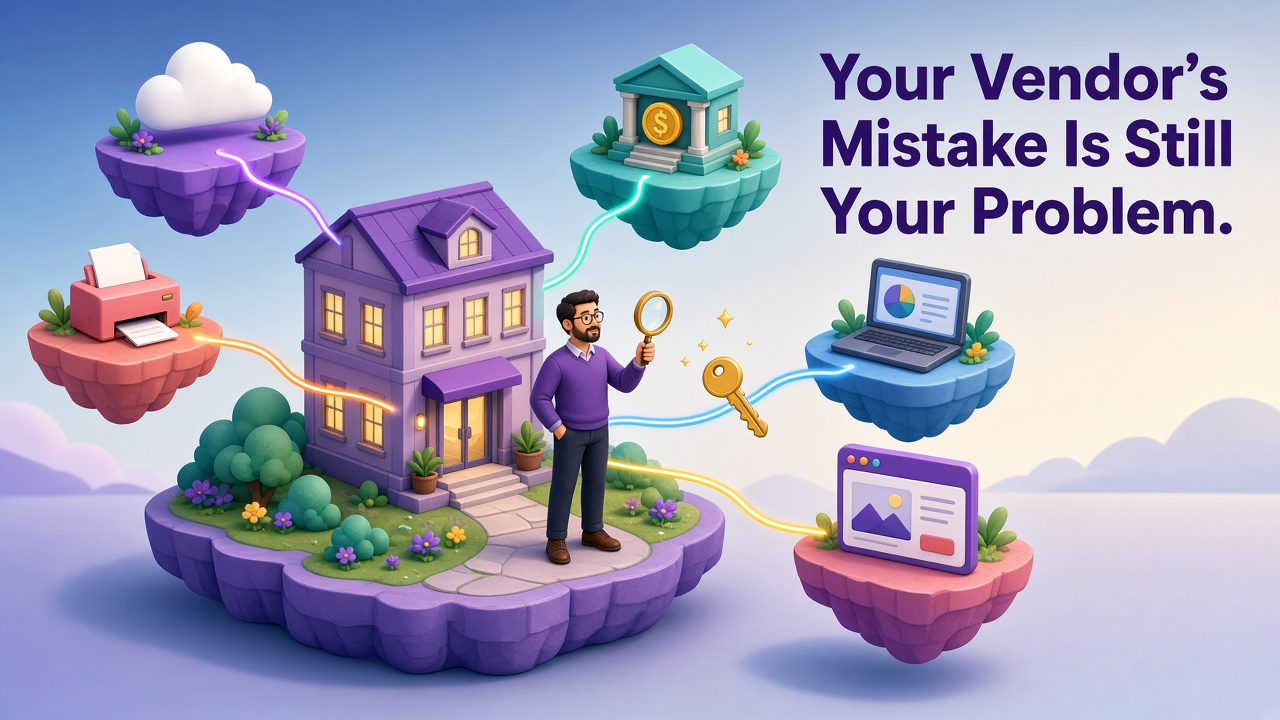
Modern small businesses run on vendors. A typical independent insurance agency in Wesley Chapel or a professional services firm in Tampa might rely on an agency management system or CRM, Microsoft 365 or Google Workspace, a cloud backup service, an e-signature platform, a payroll provider, a website host, a phone system, a copier with scan-to-email, and an IT provider.
Each of those vendors stores your data, connects to your systems, or both. Many hold keys, API tokens, or administrative accounts that work around your normal logins. If those credentials leak, an attacker doesn't need to phish your staff or break through your firewall. They can walk in through a door you didn't know was open.
Keys and tokens are a particular blind spot. They're often created once during setup, saved in a configuration file or pasted into an email, and never changed again. Unlike a password, nobody gets a reminder to rotate them every few months, so a key exposed years ago may still work today.
Vendors are also attractive targets because one breach can unlock many customers at once. Attackers have learned that compromising a single service provider can be far more efficient than attacking hundreds of small businesses one at a time.
What Vendor Risk Management Looks Like at Small Business Scale
Large enterprises have entire teams devoted to third-party risk. You don't need that. You need a repeatable process that fits on a page or two.
• Build a vendor inventory. List every vendor that stores client data or can access your systems. Include the small ones. The copier company and the website designer count.
• Rank vendors by access. A vendor with administrative access to your network or your entire client database deserves more scrutiny than one that only sends you an invoice.
• Ask questions before you sign. Do they use multifactor authentication? Do they encrypt your data? Have they had a breach? How quickly will they notify you if they do?
• Get commitments in writing. Contracts should spell out security responsibilities, how fast they'll notify you of an incident, and how your data will be returned or destroyed when the relationship ends.
• Limit what they can touch. Give vendors the least access they need to do their job, and make sure their accounts use MFA. Shared or generic vendor logins are a red flag.
• Offboard vendors as carefully as employees. When you stop using a vendor, remove their access, revoke keys and tokens, and confirm what happened to your data.
• Review once a year. Vendors change, get acquired, and add features that touch your data. A quick annual check keeps your list honest.
Questions Worth Asking Your Most Important Vendors
For your highest-risk vendors, a short conversation goes a long way. Ask how they protect the credentials and keys that connect to your systems, whether they've had a security incident in the past few years and what changed afterward, how and how quickly they would notify you if your data were affected, and whether they carry cyber insurance. A vendor that answers clearly and confidently has usually thought about it. A vendor that dodges the questions is telling you something too.
Why This Matters for Florida Insurance Agencies
For independent agencies, overseeing third-party service providers isn't optional. Florida Administrative Code Rule 69O-128.032 and the NAIC cybersecurity standards many carriers now reference both expect licensees to take reasonable steps to make sure the partners handling customer information protect it appropriately. Carriers are increasingly asking about vendor oversight during reviews and on cyber insurance applications. "We trust them" isn't a control.
That Includes Us
Here's something every business owner should hear from their IT provider: a managed service provider is a vendor too, and one with significant access to your systems. You should hold your IT provider to every standard described above. Ask how they protect their tools, how they secure their own accounts, and how quickly they would tell you about a problem. At Main Event Managed Services, we welcome those questions, and we think every client should ask them.
How Main Event Managed Services Helps
We help small businesses and insurance agencies across Wesley Chapel, Tampa, and the Tampa Bay area build practical vendor risk programs. That includes creating your vendor inventory, identifying which vendors can reach sensitive data, tightening access and MFA on vendor accounts, and mapping vendor oversight to Rule 69O-128.032 expectations. You can't control your vendors, but you can control who you pick, what they can touch, and what they've promised you.
Want a simple vendor risk checklist for your business? Reach out at contact@maineventmsp.com or visit maineventmsp.com.