Ransomware and Small Business: Why Company Size Is Not the Factor
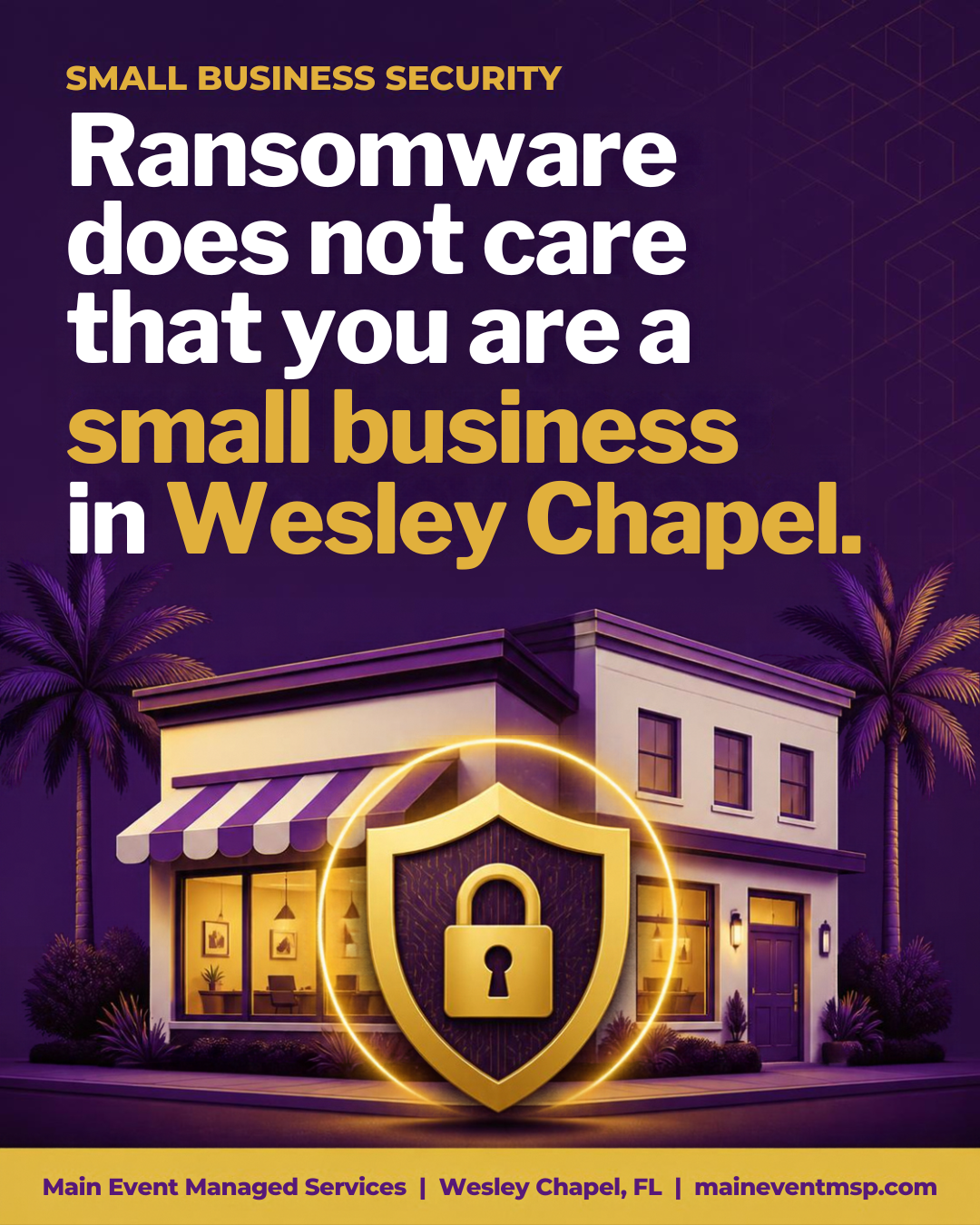
There is a common belief among small business owners that ransomware is a big-company problem, something that happens to hospitals, cities, or national brands. It is an understandable assumption, and it is also a good reason for small businesses in Wesley Chapel and across Tampa Bay to talk about this topic. Ransomware is mostly not personal. It is automated, opportunistic, and driven by whatever door happens to be open. The reassuring side of that fact is that closing the common doors, and preparing for recovery, makes a real difference for businesses of any size.
How ransomware usually finds a business
Attackers use software that continuously looks for weaknesses: an email account without multi-factor authentication, a remote access tool that was left exposed to the internet, a computer missing important updates, or a message with a link that someone clicks. When one of those doors opens, the software goes in. It does not check the company name, the number of employees, or the zip code first.
Once inside, ransomware locks files so the business cannot use them and displays a demand. Modern versions often copy data first as well, which adds a privacy dimension on top of the disruption.
The common doors, and how to close them
• Email and remote access accounts. Turn on multi-factor authentication, ideally with number matching or passkeys.
• Software updates. Keep computers, servers, and network devices updated so known weaknesses are closed.
• Endpoint protection. Modern protection with monitoring can spot and stop suspicious behavior on a computer, not just known bad files.
• Least access. Give each person access to what their job needs. If one account is compromised, the reach is limited.
• Email filtering and awareness. Filtering catches much of the risk, and a team that knows the red flags handles the rest.
Backups: the recovery safety net
A good backup is the difference between an inconvenient day and a long disruption. The practical test is not whether backups exist but whether they can be restored when needed. A widely used guideline is the 3-2-1 approach: three copies of your data, on two different types of storage, with one copy kept offsite or offline where ransomware cannot reach it.
Then test it. Choose a few files or a whole system and restore them on a regular schedule. Many businesses find that their first test reveals small gaps, and finding them on a calm day is far better than finding them on a hard one.
Three myths worth retiring
• "We are too small to be a target." Automated tools do not choose by size. They choose by what is reachable.
• "We have nothing worth taking." Customer records, email history, and the ability to keep operating all have value, both to the business and to anyone trying to disrupt it.
• "Our antivirus handles it." Traditional antivirus is one useful layer. It works best alongside multi-factor authentication, updates, tested backups, and a team that knows what to look for.
A simple plan for the hardest day
Preparation does not need to be elaborate. A one-page plan can name who to call first, who has authority to make decisions, how the team will communicate if email is unavailable, where the contact details for your IT provider, insurance carrier, and key vendors are stored (somewhere that does not depend on your own network), and how you will restore priority systems. Keep a printed copy in the office, because a plan stored only on a locked computer is not much help. Talk through it once a year. The value is mostly in having thought about it before it matters.
Why this is also a customer information question
For Florida insurance agencies, ransomware is not only an uptime issue. Agencies hold customer information, and Florida Administrative Code Rule 69O-128.032 asks each licensee to implement a comprehensive written information security program with administrative, technical, and physical safeguards for that information, scaled to the size and complexity of the business. Multi-factor authentication, updates, tested backups, access controls, and a written response plan map neatly to those safeguard categories. Building them is not extra work on top of compliance. It is the substance of it.
Where to start if this feels like a lot
If the list feels long, begin with three moves this month: turn on multi-factor authentication for email, run a test restore from your backup, and write the one-page plan. Together they cover the most common entry point, the most important safety net, and the moment of decision. Everything else can be layered in over the following weeks, in whatever order suits your business.
A quick self-check
• Is multi-factor authentication on for email and remote access?
• When did we last restore something from backup to prove it works?
• Does one copy of our backup live somewhere ransomware cannot reach?
• Does everyone know who to call first?
Main Event Managed Services works with Wesley Chapel and Tampa Bay small businesses and Florida insurance agencies to put these layers in place and document them. To talk through your setup, visit maineventmsp.com.