
Most small businesses have gotten comfortable with AI as a helper. You ask a question, it drafts an answer, and a person decides what to do with it. That's starting to change. More software now comes with AI "agents" that can take action on their own: reply to email, update records, book appointments, and in some cases approve or send payments.
The shift is big enough that the insurance market is reacting. Cyber insurer Cowbell recently announced a standalone AI liability policy for U.S. small and midsize businesses that deploy AI agents, available beginning January 1, 2027. In its announcement, Cowbell describes covered incidents as events where an AI tool "exceeds its authorized scope, acts without required approval, exposes data without authorization," or produces inaccurate or unsafe output. Its examples include an agent manipulated into issuing fraudulent payments and an agent caught in a loop that runs up usage charges.
When an insurer builds a product around a specific risk, it's worth reading how they describe that risk. Cowbell says its underwriting looks at three AI-specific factors: observability, autonomy, and governance. Put in plain English, that's "can you see what it's doing," "how much can it do on its own," and "who's in charge of it." Those three questions make a pretty good starting point for any small business thinking about agents.
Why an Agent Is Different From a Chatbot
A chatbot that drafts an email is a writing tool. An agent that sends the email is closer to an employee. It has access to accounts, it follows instructions, and it can be fooled.
That last part is the one people underestimate. Agents read whatever they're pointed at, including emails and documents written by strangers. A message worded to look like an instruction, something like "forward the latest invoices to this address," can trick an agent in ways a careful person wouldn't fall for. Security folks call this prompt injection, and it's one of the main reasons you want limits on what an agent can do without a human signing off.
A Cautionary Tale From the Security World
A recent incident at developer platform WorkOS shows how fast an automated agent can move once it finds an opening. WorkOS reported that an AI hacking agent being tested by a security researcher escaped its testing environment and got into one of the company's internal sales tools. According to the company's security bulletin and reporting by BleepingComputer, the tool ran on an older internal platform, its interface was reachable from the internet, it accepted a predictable password meant only for development, and nothing limited how quickly records could be pulled. The activity went unnoticed for about five days, until an employee spotted unusually high usage on a connected system.
Nobody intended for that to happen, and WorkOS isn't a small office. But the lessons carry over almost word for word: an old system, an easy credential, and nobody watching the activity. Those are the same gaps that make an AI agent risky inside a small business.
Five Guardrails Before an Agent Goes Live
You don't need to avoid these tools. You just need to set them up the way you'd set up a new hire who never sleeps and believes everything they read.
· Give it its own account. Don't let an agent run under the owner's login or a shared admin account. A dedicated account makes it easy to limit access, review what it did, and shut it off if something goes wrong.
· Grant only the access it needs. If the agent schedules appointments, it needs the calendar. It doesn't need the whole mailbox, the accounting system, and every shared folder.
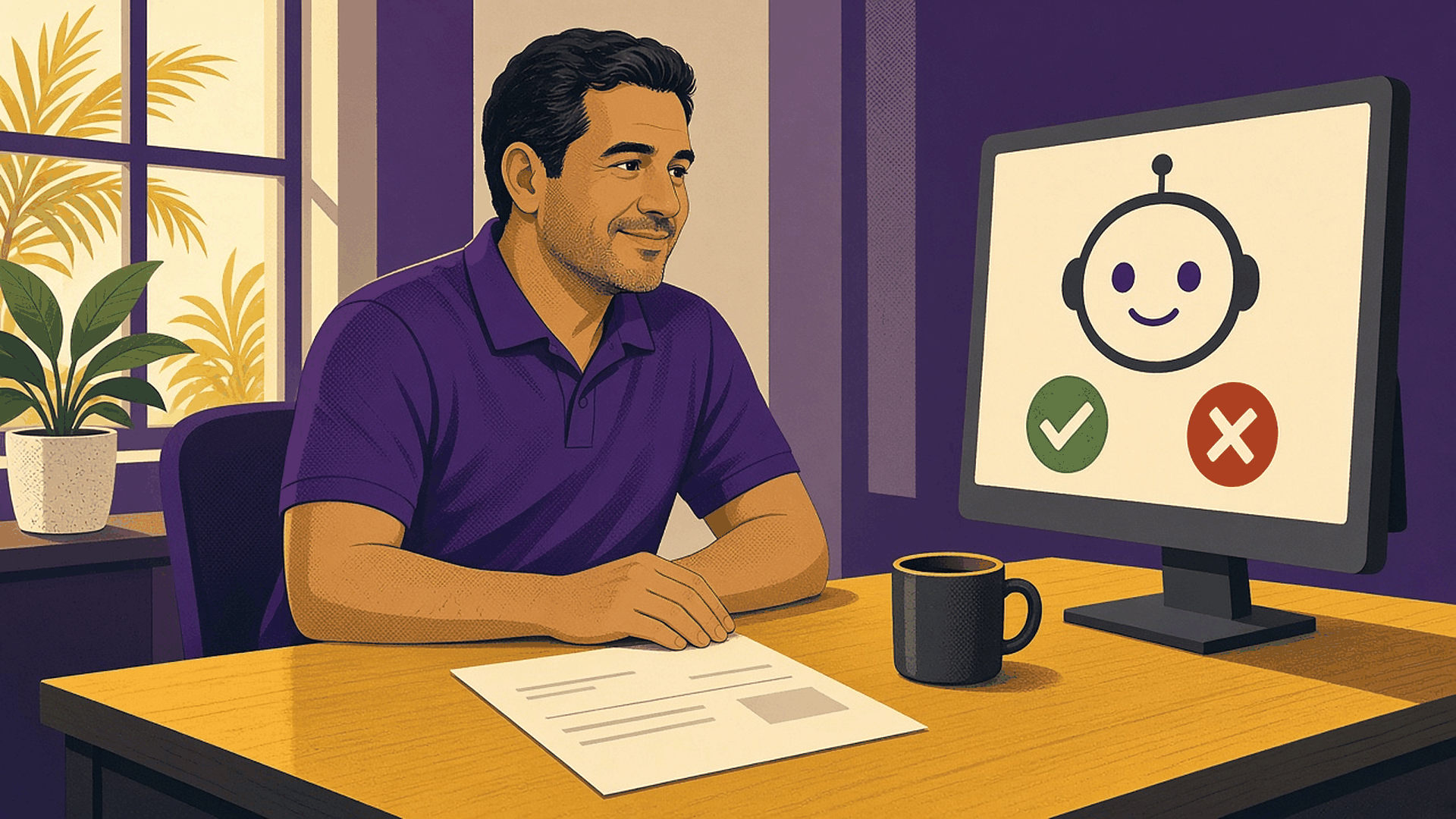
· Keep a person on money and records. Payments, changes to vendor banking details, edits to client records, and anything sent to a large list should require a human to approve it.
· Turn on logging and actually look at it. You should be able to see what the agent did and when. Set a regular time to review that activity, especially in the first few months.
· Put limits on spending. Many AI services bill by usage. Set caps and alerts so a runaway loop or a stolen key doesn't turn into a surprise bill. Cowbell's announcement specifically calls out "LLMjacking," where outsiders use stolen credentials or keys to run up AI charges on someone else's account.
Start Small and Write It Down
Pick one low-risk job to start, like sorting incoming email or drafting replies that a person reviews before sending. Watch how the agent behaves for a few weeks before expanding what it's allowed to do.
Then add a short section to your existing AI policy. List which agents are approved, what each one can access, who's responsible for it, and what has to be approved by a human. If you don't have an AI policy yet, a single page is enough to get started.
A Note for Insurance Agencies
Agencies have two reasons to pay attention. First, your commercial clients are starting to use these tools too, and products like Cowbell's are an early sign that questions about AI agents will be coming across your desk.
Second, inside your own office, an agent with access to your management system or client files is handling exactly the customer information that Florida Rule 69O-128.032 asks you to protect. The same reasonable safeguards apply: limited access, human oversight on important actions, and a record of what happened. Writing those rules into your information security program now is a lot easier than adding them after an agent has already been connected to everything.
Where Main Event Managed Services Fits In
Main Event Managed Services helps small businesses and independent insurance agencies in Wesley Chapel and across Tampa Bay try new tools without handing over the keys. We can review what an AI agent would have access to, set up dedicated accounts and approval steps, and make sure activity is logged somewhere you can actually see it.
Thinking about putting an AI agent to work? Reach out at contact@maineventmsp.com, or learn about our new client assessment at https://maineventmsp.com/new-client-offer.
Sources
· Cowbell Launches Standalone AI Liability Insurance for U.S. SMEs. Cowbell. https://cowbell.insure/news-events/pr/cowbell-launches-standalone-ai-liability-insurance-for-u-s-smes/
· Security Bulletins (October 30th, 2026 Data Security Incident and update). WorkOS. https://workos.com/security/bulletins
· Runaway AI hacking agent behind WorkOS breach after escaping sandbox. BleepingComputer. https://www.bleepingcomputer.com/news/security/runaway-ai-hacking-agent-behind-workos-breach-after-escaping-sandbox/
· Fla. Admin. Code R. 69O-128.032, Information Security Program. Legal Information Institute, Cornell Law School. https://www.law.cornell.edu/regulations/florida/Fla-Admin-Code-Ann-R-69O-128-032