
Why Your Small Business Needs a Password Manager (Sticky Notes Are Not a Backup Plan)
The Habit Almost Every Small Business Falls Into
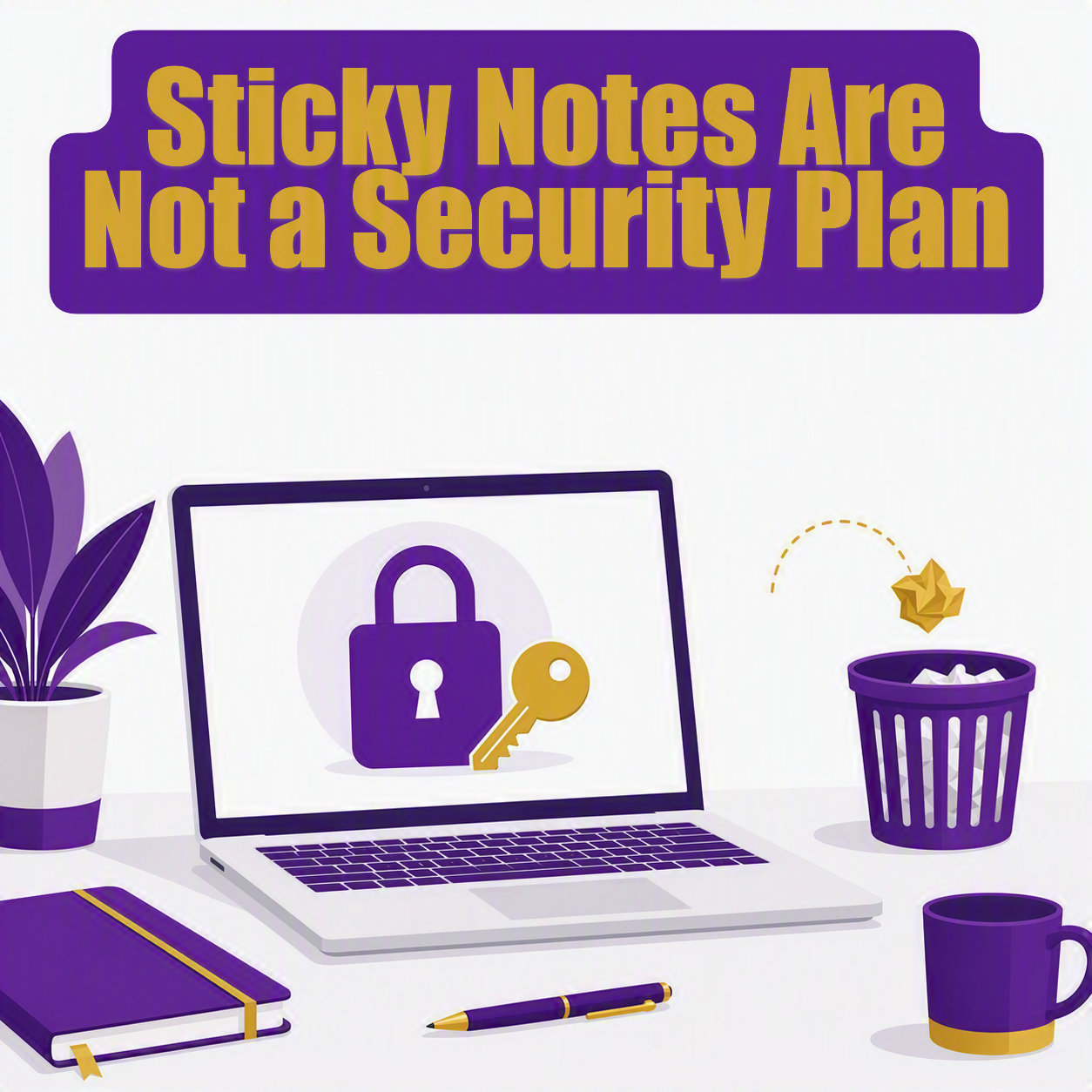
Walk into almost any small business in Tampa Bay or Wesley Chapel and you will likely find at least one password written down somewhere it should not be. A sticky note on a monitor. A spreadsheet labeled "passwords" sitting in a shared drive. A browser set to remember everything on a computer the whole office uses. None of this happens because business owners do not care about security. It happens because managing dozens of logins across email, banking, vendor portals, and software platforms is genuinely hard, and there has never been an easy alternative sitting right in front of most small teams. That is exactly what a password manager fixes.
Why Sticky Notes and Autofill Are Riskier Than They Feel
A password written on paper feels private because it is not on the internet, but it is visible to anyone who walks past the desk, including customers, vendors, and cleaning crews after hours. Browser autofill feels safer because it is digital, but it ties every saved password to whichever device it lives on. If that laptop is lost, stolen, or infected with malware, every saved credential can potentially be exposed at once. Reused passwords compound the problem. If an employee uses the same password for a vendor portal and their email, a breach at that vendor can hand an attacker the keys to your inbox too.
What a Password Manager Actually Does
A business password manager creates and stores a long, unique, randomly generated password for every account your team uses, then fills it in automatically when needed. Employees only need to remember one strong master password (or use biometric login) to unlock their vault. Because every password is unique, a breach at one vendor no longer threatens every other account tied to that employee. Most business grade tools also let an owner see, at a glance, which employees are reusing passwords, which accounts are missing multi factor authentication, and which credentials need to be rotated.
What This Looks Like for a Team of 5 to 25 People
For a small business, rollout is usually straightforward. Employees install a browser extension and mobile app, import any existing saved passwords, and start generating new ones going forward. Shared logins, such as a company social media account or a shared vendor portal, can be stored in a shared vault so multiple employees can use the credential without ever actually seeing the password itself. If someone leaves the company, access is revoked in seconds instead of requiring a scramble to change every password they might have known.
What to Look For in a Business Password Manager
Not every password manager is built for a business environment. Consumer grade tools designed for individuals often lack the features a small business actually needs, such as centralized administration, shared vaults for team accounts, and visibility into overall password health across every employee. When evaluating options, look for a tool that supports multi factor authentication on the vault itself, allows an administrator to see (without exposing the actual passwords) which employees have weak or reused credentials, and integrates cleanly with the systems your business already uses. Pricing is typically per user per month and is modest compared to almost any other security investment a small business can make.
Common Objections We Hear, and Why They Do Not Hold Up
"My team will never adopt something new." In practice, adoption is usually smoother than owners expect, because a password manager removes friction rather than adding it. Employees stop needing to remember dozens of passwords or reset forgotten ones, which is a common source of help desk tickets in the first place. "We are too small to be a target." Attackers frequently do not choose targets based on size, they choose based on ease of access, and small businesses without basic protections in place are often easier targets than larger companies with dedicated security teams. "We already have antivirus, isn't that enough?" Antivirus and a password manager address different problems entirely. One looks for malicious software, the other prevents an attacker from simply logging in with a stolen or guessed password in the first place.
How This Fits Into a Broader Security Picture
A password manager is not a complete cybersecurity strategy on its own, but it is one of the highest impact, lowest effort pieces of a broader plan. Paired with multi factor authentication, regular software updates, and basic employee awareness training, it addresses one of the most commonly exploited weaknesses in small business networks: weak or reused credentials. Because it requires no new hardware and minimal ongoing maintenance, it is often one of the first recommendations we make when a Tampa Bay or Wesley Chapel business is starting to take security seriously for the first time.
A Simple Next Step
You do not need to overhaul your entire security posture this week to make progress. Rolling out a password manager is one of the fastest, lowest cost improvements a small business can make, and it directly closes one of the most common gaps we find during security assessments across Tampa Bay and Wesley Chapel. If you are not sure where to start or which tool fits your team size and budget, that is exactly the kind of conversation worth having before your next renewal or compliance review.