

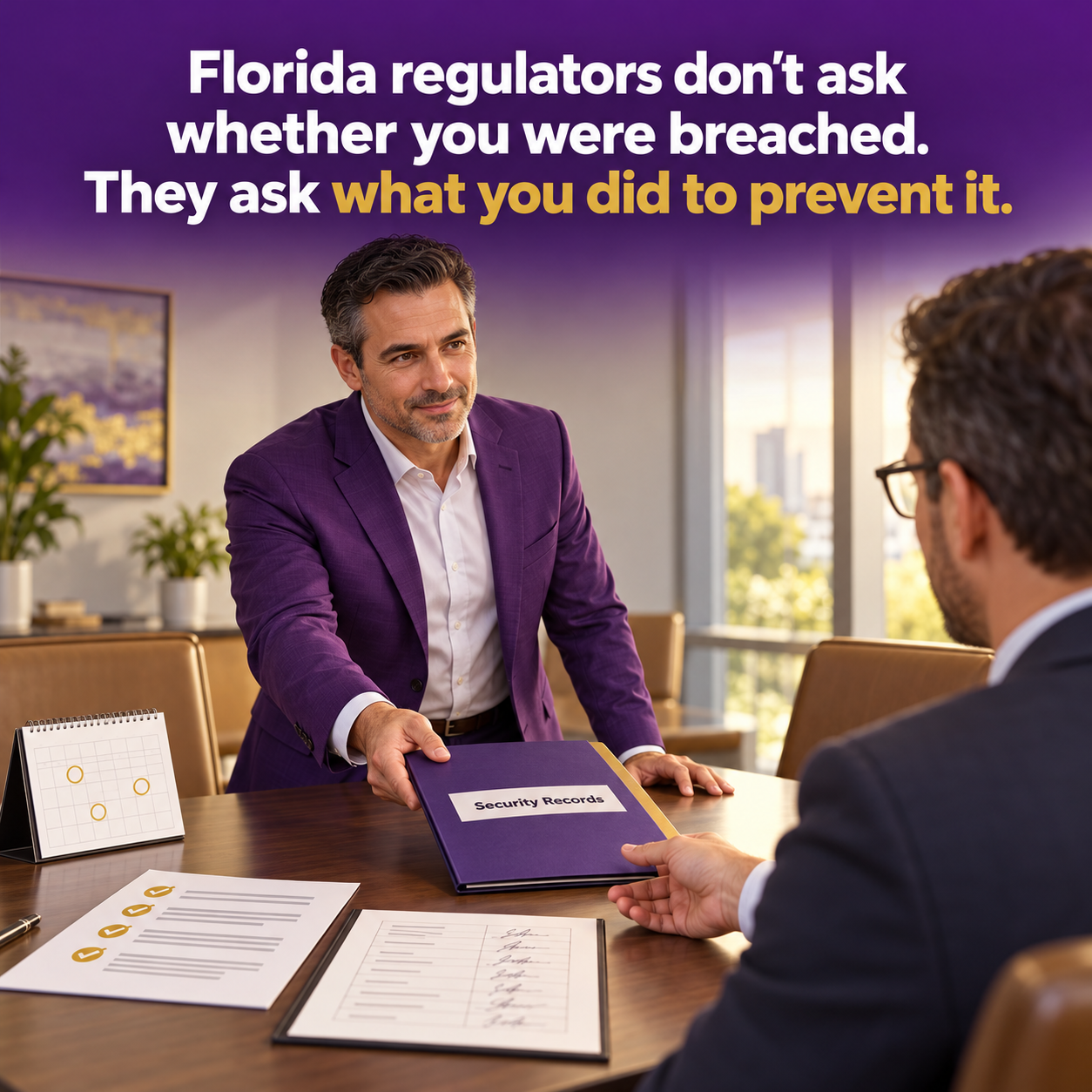
There is a common misconception among small business owners that a data breach is primarily a question of luck. Either attackers find you or they do not. And if they do, the damage is simply bad fortune.
The reality is different, especially for Florida insurance agencies. When a security incident happens, the questions that follow focus less on whether you were breached and much more on what you did beforehand. Did you take reasonable steps to protect the information? Can you show it?
Breaches happen to careful, well-run businesses. What often separates a manageable incident from a disaster is whether the business can demonstrate that it was doing the right things all along.
Who Asks the Questions
After a security incident, several parties may want to understand how your agency was protecting information:
• Insurance regulators reviewing compliance with Florida Rule 69O-128.032
• The Florida Attorney General's office, depending on the size and nature of the breach
• Your cyber insurance carrier, evaluating the claim against what you stated on your application
• The carriers you represent, who entrusted you with their policyholders' information
• Your clients, who want to know whether their information was handled responsibly
Each of them is essentially asking the same thing: what safeguards were in place, and were they actually working?
What Florida Rules Expect
Florida Administrative Code Rule 69O-128.032 expects insurance licensees to maintain a written information security program with administrative, technical, and physical safeguards appropriate to the agency's size, complexity, and the sensitivity of the customer information it holds.
The Florida Information Protection Act of 2014, found in section 501.171 of the Florida Statutes, adds further obligations. It requires covered entities to take reasonable measures to protect personal information. When a breach occurs, it generally requires notice to affected individuals no later than 30 days after the breach is determined or there is reason to believe one occurred. If 500 or more Florida residents are affected, notice to the Florida Department of Legal Affairs is generally required as well. Third-party agents that maintain data on your behalf have their own obligation to notify you of a breach promptly.
Those timelines move fast, and they leave little room to figure things out from scratch. This is general information rather than legal advice, so involve your attorney to understand how these requirements apply to your specific situation.
"Reasonable" Is Proven With Evidence
The word reasonable appears again and again in data protection rules. It does not mean perfect. It means appropriate to your business and actually in practice. And the most convincing way to show reasonable security is with records created before anything went wrong.
Here is what that evidence typically looks like for a small agency:
A current written information security program
Not a template from years ago, but a document that reflects your systems and workflows today, with a record of when it was last reviewed.
Training records
Dated sign-offs showing employees completed security awareness training, including phishing awareness and how to report suspicious activity.
Technical controls in place
Multi-factor authentication on email and key systems, endpoint protection on every computer, regular software updates, and access limited to people who need it.
Access reviews
Documentation showing you periodically reviewed who has access and promptly removed former employees and vendors.
Backup and recovery tests
Records showing backups ran and restores were tested successfully.
An incident response plan you have practiced
A written plan that defines who does what during an incident, along with notes from a tabletop exercise where your team walked through a realistic scenario.
Vendor oversight
Evidence that you considered the security of service providers who handle customer information on your behalf.
Build Your Compliance File Now
One practical habit makes a big difference: keep a simple compliance file. Every time your agency completes a security activity, such as a training session, an access review, a backup test, or a policy update, add a dated record to the file.
Over a year, that file becomes a clear story of a business taking security seriously. If something ever does go wrong, you will not be scrambling to reconstruct what happened. You will be able to hand over evidence.
This approach also pays off well before any incident. Cyber insurance applications, carrier audits, and client security questionnaires become much easier when the answers are already documented.
Consistency Beats Complexity
You do not need a large IT department to build a defensible security record. Small agencies in Wesley Chapel and across Tampa Bay can do this well by focusing on consistency: a monthly habit here, a quarterly review there, and an annual check of the overall program.
"We meant to get to it" is not a defense. A dated record of what you did is.
Get Ahead of the Questions
From my years inside a specialty insurance carrier, I learned how much weight documentation carries when something goes wrong. Main Event Managed Services helps independent agencies throughout the Tampa Bay area build security programs that hold up to scrutiny, along with the evidence to prove it. Visit maineventmsp.com and let's make sure you have strong answers ready before anyone asks.