

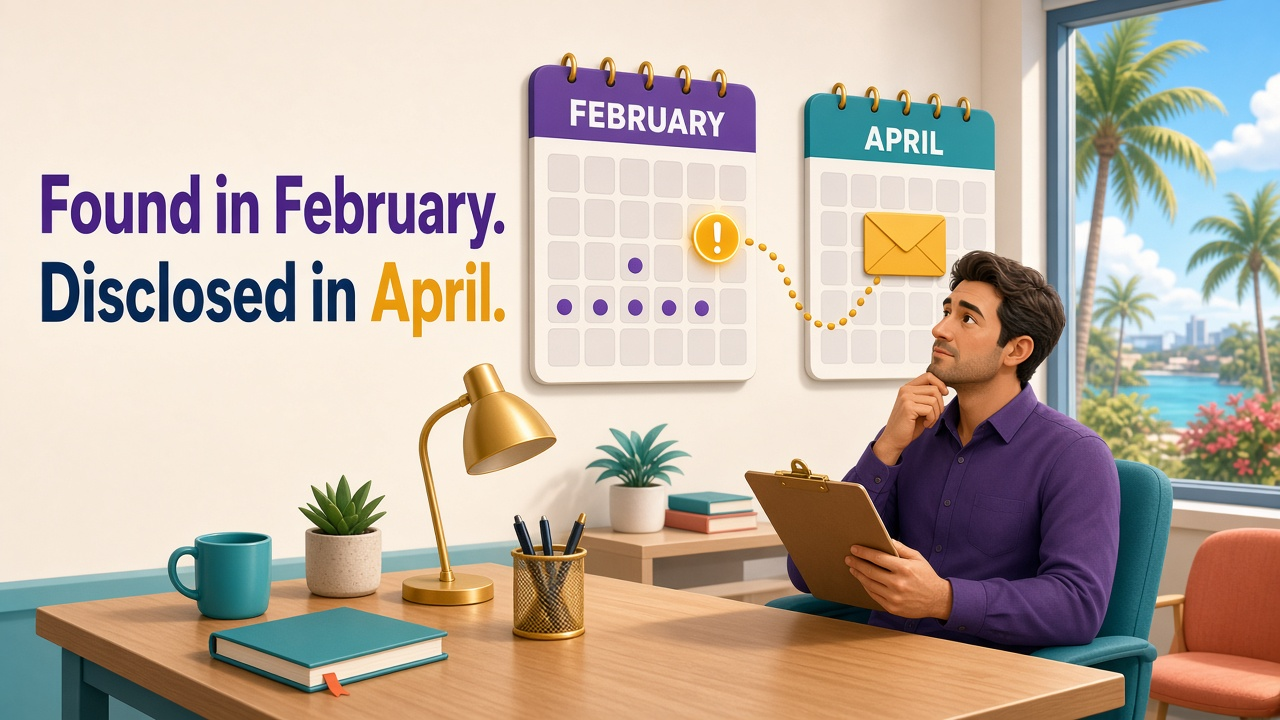
Earlier this year, TransGlobal P&C Insurance Agency, an independent property and casualty agency based in Monrovia, California, experienced a cyberattack. According to public reporting, the unauthorized access likely began around February 18, 2026. The agency discovered it on February 24. The California Attorney General was notified on April 29, and affected customers were offered credit monitoring and identity protection services.
That timeline, roughly ten weeks between discovery and public disclosure, is worth a closer look. Not to criticize one agency. Forensic investigations take real time, and from the outside nobody has the full picture. But every independent agency owner in Wesley Chapel, Tampa, and across Florida should look at that gap and ask a simple question: if this happened to us, how long would it take us to know what happened, who was affected, and what we owe them?
Why the Gap Happens
Most delays aren't about hiding anything. They come from a handful of very ordinary problems.
Nobody knows who's in charge. A staff member notices something odd, mentions it to the owner, and the owner calls whoever set up the computers. Days go by while people figure out whether the problem is even real.
The evidence isn't there. If your systems aren't keeping logs, or only keep a few days of them, investigators can't reconstruct what the attacker touched. When you can't prove what wasn't accessed, you often have to assume everything was. That makes the investigation longer and the notification list bigger.
The data is scattered. Client files live in the agency management system, in email attachments, on a shared drive, in someone's downloads folder, and on a laptop that went home for the weekend. Figuring out whose information was exposed means first figuring out where it all lives.
Outside help gets called late. Cyber insurance policies typically require prompt notice to the carrier and often route you to approved breach counsel and forensic firms. Agencies that start wiping machines on their own, and only then call the carrier, can create both coverage headaches and lost evidence.
The Florida Clock Starts Sooner Than You Think
Florida doesn't leave much room for a slow start. Under the Florida Information Protection Act (Section 501.171, Florida Statutes), businesses generally must notify affected Florida residents no later than 30 days after determining a breach occurred, or after having reason to believe one did. If 500 or more Floridians are affected, the Florida Department of Legal Affairs must also be notified within that same window.
Insurance agencies have another layer. Florida Administrative Code Rule 69O-128.032 sets expectations for how licensees safeguard customer information, and the NAIC cybersecurity standards that carriers increasingly hold their agency partners to emphasize having a written incident response plan. When a regulator or carrier asks what you did and when, "we were still figuring it out" is not a strong answer.
Thirty days sounds like plenty of time until you spend the first ten of them trying to find your cyber carrier's claims hotline.
What a Ready Agency Looks Like
Being prepared doesn't require a big budget or a full-time security team. It requires a few decisions made ahead of time.
• Write a one-page first-hour plan. List who gets called and in what order: your cyber carrier's incident hotline, the breach counsel they recommend, your IT provider, and the person inside the agency who makes decisions. Print it. A plan stored only on the server that just got encrypted doesn't help anyone.
• Know where client data lives. Make a simple inventory of every place personal information is stored, including your agency management system, email, file shares, scanned documents, carrier portals, and any personal devices staff use. The shorter that list, the faster any investigation goes.
• Turn on logging and keep it. Microsoft 365 sign-in and audit logs, endpoint protection alerts, and firewall logs are the breadcrumbs investigators need. Make sure they're enabled and kept long enough to look back weeks, not days.
• Don't destroy evidence. Train your team that the first move is to disconnect a suspicious computer from the network, not to wipe it, reinstall it, or run random cleanup tools. Preserving the scene is what lets investigators narrow down what happened.
• Practice once a year. A tabletop exercise is simply sitting your team down and walking through a scenario, such as: "A client calls saying they got a strange email from our address asking for a payment. What do we do?" Thirty to sixty minutes of discussion will expose more gaps than any document review.
Speed Builds Trust
Clients understand that cyberattacks happen. What damages trust is the feeling that the agency didn't know what was going on, or waited too long to tell them. An agency that can say, "We detected this quickly, we brought in experts the same day, and here's exactly what we know," keeps relationships that a slower, more confused response might lose.
Insurance is a business built on being prepared for the bad day. Your own agency deserves the same planning you help your clients put in place.
How Main Event Managed Services Helps
Main Event Managed Services works with independent insurance agencies in Wesley Chapel, Tampa, and throughout the Tampa Bay area to build incident response plans that actually get used. That includes mapping where client data lives, making sure the right logs are captured and retained, aligning your safeguards with Rule 69O-128.032, and running tabletop exercises with your team so the first hour of a real incident isn't the first time anyone has thought about it.
Want to talk through your agency's readiness? Reach out at contact@maineventmsp.com or visit maineventmsp.com.